
Embedding Islamic Values into Agile Delivery


A free, Open-Source approach for Muslim-led teams to align daily operational decisions with Islamic values through Scrum, Kanban, and SAFe.
Ihsan Agile is intentionally modular. Teams can try a single practice, reflection, or idea without adopting the framework as a whole.
Now includes v1.2 updates: sidq (truthfulness) as a Fourth Pillar, expanded guidance on technical disclosure, stewardship, and uncertainty management.
We're witnessing an exciting moment in Muslim tech and Islamic enterprise. Organisations articulate inspiring Islamic principles.
The Muslim Tech Manifesto energises developers. Islamic fintech and tech startups multiply. Ma Sha Allah. Alhamdulillah! There is energy, conviction, and vision.
Many successful teams maintain Islamic values through strong culture, individual judgment, and shared understanding. Most use established Agile methods (Scrum, Kanban, SAFe) to manage their delivery work.
As teams grow and evolve, they naturally ask: how do we translate Islamic principles into the daily Agile practices our teams already use? How do we enrich sprint planning, retrospectives, and stakeholder engagement with our values, without replacing the methods that already work?
Everyday Delivery Decisions
Consider the everyday decisions teams navigate:
A development team balancing testing thoroughness with delivery deadlines
A Scrum Product Owner weighing feature priorities: conversion metrics or user wellbeing?
A designer choosing between engagement optimisation and transparent interactions
A team managing technical debt: how to balance speed with future sustainability?
These decisions touch on justice (ʿadl), trust and stewardship (amānah), transparency, and care for stakeholders. They're not "Shariah decisions" requiring formal governance, yet they shape whether organisations actively embody Islamic values or gradually drift.
As teams move quickly, ethical risk often doesn’t come from intent, but from undisclosed uncertainty (gharar): shortcuts, limitations, or trade-offs that are known internally but inherited by others without consent. Ihsan Agile treats this not as “technical debt” to be paid back later, but as an obligation of disclosure (technical disclosure) at the point decisions are made.
Muslim-led organisations and teams care deeply about Islamic values. The question is: How do we embed those values into the Agile ceremonies and practices teams already use?
How do we make values systematic, teachable, and sustainable, without starting from scratch or replacing what works?
This is where Ihsan Agile provides a practical approach: an overlay onto existing Agile methods that enriches what teams already do, rather than replacing it.
Making Values OperationaL
Core Practices
Ihsan Agile is intentionally modular. You can try a single practice without adopting roles or the full framework. Each practice is designed to embed Islamic principles into existing Agile workflows.
Niyyah Check-ins
Embedding conscious intention into planning
At the start of planning cycles, teams pause to clarify purpose before committing to work. Not just "what are we building," but "why does this matter? Who benefits? Who might be harmed?"
This practice transforms Sprint Goals from output commitments into purpose-driven intentions, ensuring work begins with consciousness of service (khidmah) and accountability before Allah (SWT).
Time: 2-3 minutes | Embeds: Taqwā (God-consciousness), Service & Justice
Muhasabah Retrospectives
Self-accounting as continuous purification
Before discussing process improvements, teams engage in ethical reflection rooted in the Islamic practice of muhāsabah (self-accounting): Where did we embody iḥsān? Where did we fall short? What habits should we start or stop?
This practice connects team reflection to the broader Islamic concept of tazkiyah (purification and growth), making retrospectives not just about velocity but about character development through work.
Time: 5-10 minutes added to existing Retros | Embeds: Tazkiyah (Continuous Growth), Taqwā
Ethical Definition of Done
Expanding quality beyond functional correctness
Teams extend their Definition of Done to include justice, stewardship, and transparency criteria alongside technical requirements. Work isn't "done" until it's been evaluated for accessibility, stakeholder dignity, environmental impact, and disclosed constraints.
This practice operationalises the principle that excellence (iḥsān) encompasses not just what works, but what serves maṣlaḥah with justice.
Integration: Expanded criteria in existing DoD | Embeds: Iḥsān (Excellence), Service & Justice, Stewardship
Stakeholder Barakah Reviews
Measuring success by uplift, not just satisfaction
Sprint Reviews are enhanced to ask stakeholders about genuine benefit: "Did this create uplift? Was it fair? What unintended harms need addressing? Were you adequately informed about limitations?"
This practice shifts success metrics from customer satisfaction to whether work created barakah (blessing) in the world, centring maṣlaḥah as the measure of value.
Integration: Enhanced Sprint Review facilitation | Embeds: Maṣlaḥah (Public Good), Shūrā, Service & Justice
Shura as Decision Practice
Structured consultation with affected voices
Before major decisions, especially those involving technical shortcuts, teams ensure affected voices are heard: "Who will bear the consequences of this decision? Have we consulted them? What concerns should we consider?"
This practice operationalises the Quranic principle of shūrā (mutual consultation) by making consultation structural rather than optional, particularly for decisions that transfer risk to others.
Integration: Facilitation technique during planning and decision points | Embeds: Shūrā (Consultation), Service & Justice
Each practice can work standalone. Try one for 2-3 sprints. If it surfaces useful insights, consider adding another. The practices are designed to be additive, not all-or-nothing.
Start Small, Build Gradually
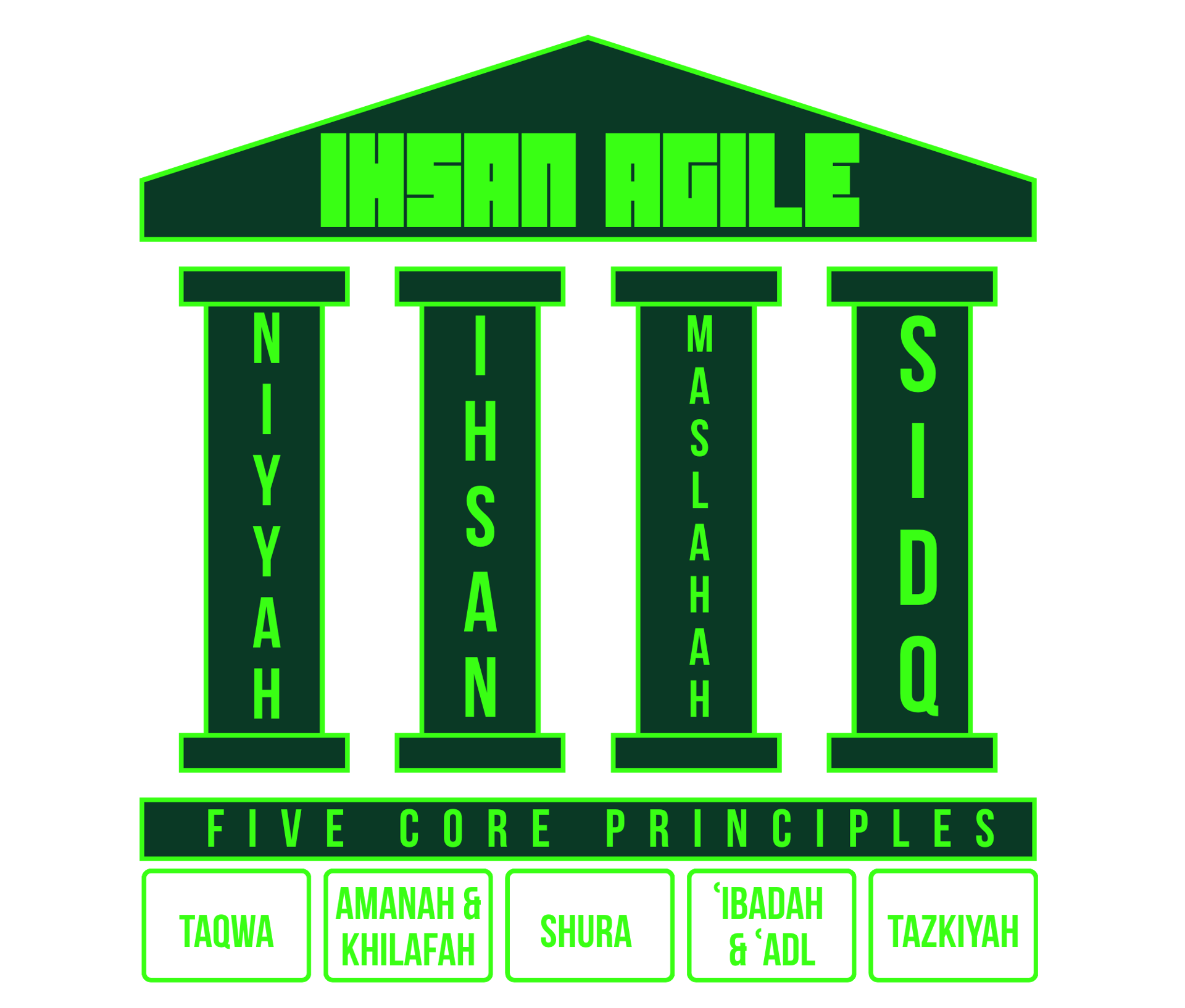
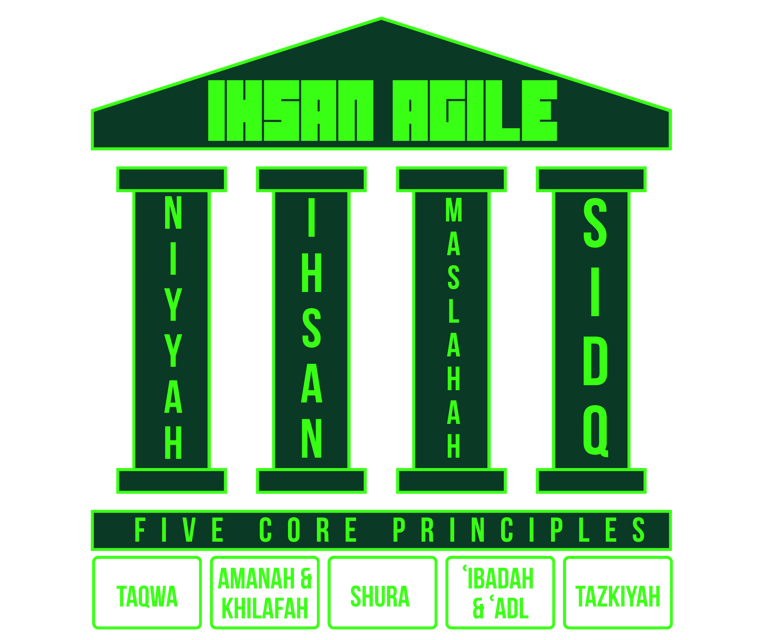
The FOUR Pillars of Ihsan Agile
Ihsan Agile is built on four foundational dimensions of ethical, God-conscious work
PILLAR 1:
Niyyah نِيَّةٌ (Intention)
Clarify the purpose and higher aim of every sprint, flow, or initiative.
Work begins with conscious intention directed towards Allah (SWT) and service to His creation. Every planning cycle starts with: "Why are we building this? Who benefits? How does this serve maslahah?"
Strive for beauty, quality, and meaningful impact in all deliverables and interactions, as though Allah (SWT) sees every detail.
Excellence infused with consciousness. Every line of code, every interaction, every decision is witnessed by Allah (SWT) and has consequences for His creation.
Orient all work towards genuine benefit, not output for its own sake, but service that uplifts people and communities.
Maṣlaḥah becomes like a qibla for work: Does this work create genuine benefit? Success is measured by uplift, not just velocity.
PILLAR 2:
Ihsān إحسان (Excellence with God-consciousness)
PILLAR 3:
Maslahah مَصْلَحَة (Public Good)
These pillars are operationalised through Five Core Principles and practical ceremonies embedded into your existing Agile workflows, whether you use Scrum, Kanban, or SAFe.
Read the Complete Framework ↓
Ṣidq is truthfulness in word and deed, the alignment between what we know internally and what we communicate externally.
It goes beyond avoiding lies: not disclosing known constraints, technical shortcuts, or capacity limitations to those who will be affected constitutes lying by omission, creating gharar (harmful uncertainty) for stakeholders who trust us.
In practice, this means sprint commitments reflect honest capacity, technical constraints are disclosed rather than hidden as internal "debt," and status updates tell the truth about progress and blockers, even when uncomfortable. Ṣidq also requires the right conditions: teams cannot speak truthfully in environments that punish honesty, which is why psychological safety is not just good practice in Ihsan Agile, but an Islamic requirement.
NEW PILLAR 4 (Version 1.2):
Sidq صِدْق (Truthfulness)
Two Optional Roles to Systematise Practice
To make individual Ihsan Agile practices more systematic and keep teams accountable as they scale with them, there are two optional companion roles that can help.
These are not new hires, but enrichments of roles you likely already have:
The Ihsan Agile Facilitator (IAF) embeds ethical consciousness into how teams work
The Ihsan Agile Product Steward (IAPS) embeds ethical stewardship into what teams build
You don't need both. You might not need either at first. But when you're ready to move from experiment to rhythm, these roles are designed to provide structure.
Five Core Responsibilities
Facilitate Niyyah Check-ins — 2-3 minutes at planning to clarify "why?" and "who benefits?"
Transform Retrospectives into Muhāsabah — 5-10 minutes of ethical reflection: "Where did we embody ihsan? Where did we fall short?"
Embed Justice in Definition of Done — Add criteria for transparency, stewardship, accessibility, dignity
Conduct Stakeholder Barakah Reviews — Ask: "Did this create uplift? Was it fair? What harms need addressing?"
Support Shūrā (Consultation) — Ensure affected voices are heard in decisions
The Ihsan Agile Facilitator
The Ihsan Agile Facilitator (IAF) is a companion-coach who embeds ethical consciousness into routine workflows. The IAF answers the question: "Who ensures everyday decisions actively express Islamic values?"
This isn't a new hire. The IAF role is typically held by your current Scrum Master, Agile Coach, or team lead—or rotates amongst team members in smaller teams.
The IAF is:
Complementary, not replacement: Adds ethical layer to facilitation you're already doing
Helps small and scaling teams make implicit ethical practices explicit, systematic, and scalable.
Lightweight: Adds 2-10 minutes to existing ceremonies, not hours
Framework-agnostic: Adapts to Scrum, Kanban, or SAFe
Operationally focused: Daily and weekly practice, not periodic governance
Learn more about the IAF↓
From Principles to Practice
Core Responsibilities
Reframe technical debt as technical disclosure
Shift focus from future “repayment” to present-time responsibility and transparency.Maintain the Technical Uncertainty Register
Make known risks, assumptions, and limitations explicit, traceable, and reviewable.Ensure informed stakeholder consent
Confirm that those affected by uncertainty understand the trade-offs being made.Centre maṣlaḥah in product decisions
Weigh business value alongside public good, long-term harm, and sustainability.Steward long-term care
Hold responsibility for the system beyond the current sprint, roadmap, or team.
The Ihsan Agile Product Steward
The Ihsan Agile Product Steward (IAPS) ensures that technical risks, limitations, and trade-offs are disclosed to those who will bear them.
This isn't a new hire. The IAPS role is typically held by your current Product Owner, Product Manager, or Tech Lead—extending their existing responsibilities with ethical stewardship.
The IAPS is:
Not a new role hire
Typically your existing Product Owner, Product Manager, or Tech Lead with 10-20% additional focus on disclosure and stewardship.
Complementary, not a replacement
Enriches Product Owner/Manager role with systematic transparency and stakeholder protection
Framework-agnostic
Works with Scrum, Kanban, SAFe, or hybrid delivery models.
Stakeholder-oriented
Attends to who is affected by delivery decisions, not just what is shipped.
Lightweight
Operates through existing ceremonies and artefacts, not parallel governance structures.
Ethically accountable
Ensures that shortcuts, limitations, and uncertainty are treated as amānah (trust), not hidden liabilities.
Learn more about the IAPS ↓
Strengthening Product Decisions Under Uncertainty
Starting Points: Which Role, When?
Start with neither role
If you're just experimenting with a single practice or two. Try Niyyah Check-ins or Muhāsabah reflections without formal role assignment.
Consider the IAF role when:
Practices prove valuable but feel inconsistent
You want ethical reflection embedded in every sprint
Your Scrum Master or Coach wants to systematise values-based facilitation
Who holds it: Typically your current Scrum Master, Agile Coach, or a rotating team member
Consider the IAPS role when:
You're building products with significant external stakeholder impact
Technical decisions create risks users should know about
Transparency gaps are your biggest concern
Who holds it: Typically your current Product Owner, Product Manager, or Tech Lead
Use both roles when:
Building high-stakes products (fintech, healthcare, education) where both how you work and what you build require systematic ethical oversight.
Remember: These roles don't require new hires, new budgets, or organisational restructuring. They're ways of enriching the work your team already does.
Getting Started
Ihsan Agile is for you if...
You're a Scrum Master or Agile Coach wanting to embed Islamic ethics into ceremonies you already facilitate
You're a Product Owner or Team Lead seeking to operationalise values in backlog decisions
You're a Muslim developer or designer wanting your daily work to reflect Islamic principles structurally
You're leading an Islamic charity, NGO, or Muslim tech company committed to values-aligned delivery
Start with a single practice:
Try a Niyyah Check-in at your next Sprint Planning
Add Muhāsabah reflection to your next Retrospective
Expand your Definition of Done with one ethical criterion
If building products with stakeholder risk, start a Technical Uncertainty Register
Run it for 2-3 sprints. See what it surfaces. Continue only insofar as reflection remains helpful.
When practices prove valuable and you want to systematise them, consider whether the IAF or IAPS roles would help make values-based work sustainable as you scale.
Guide: https://ihsanagile.org/guide
Explore pilot opportunities: https://tally.so/r/7Rb7dP
“The Ihsan Agile Guide addresses a critical gap: how Muslim-led teams can translate Islamic principles into daily Agile practices.”
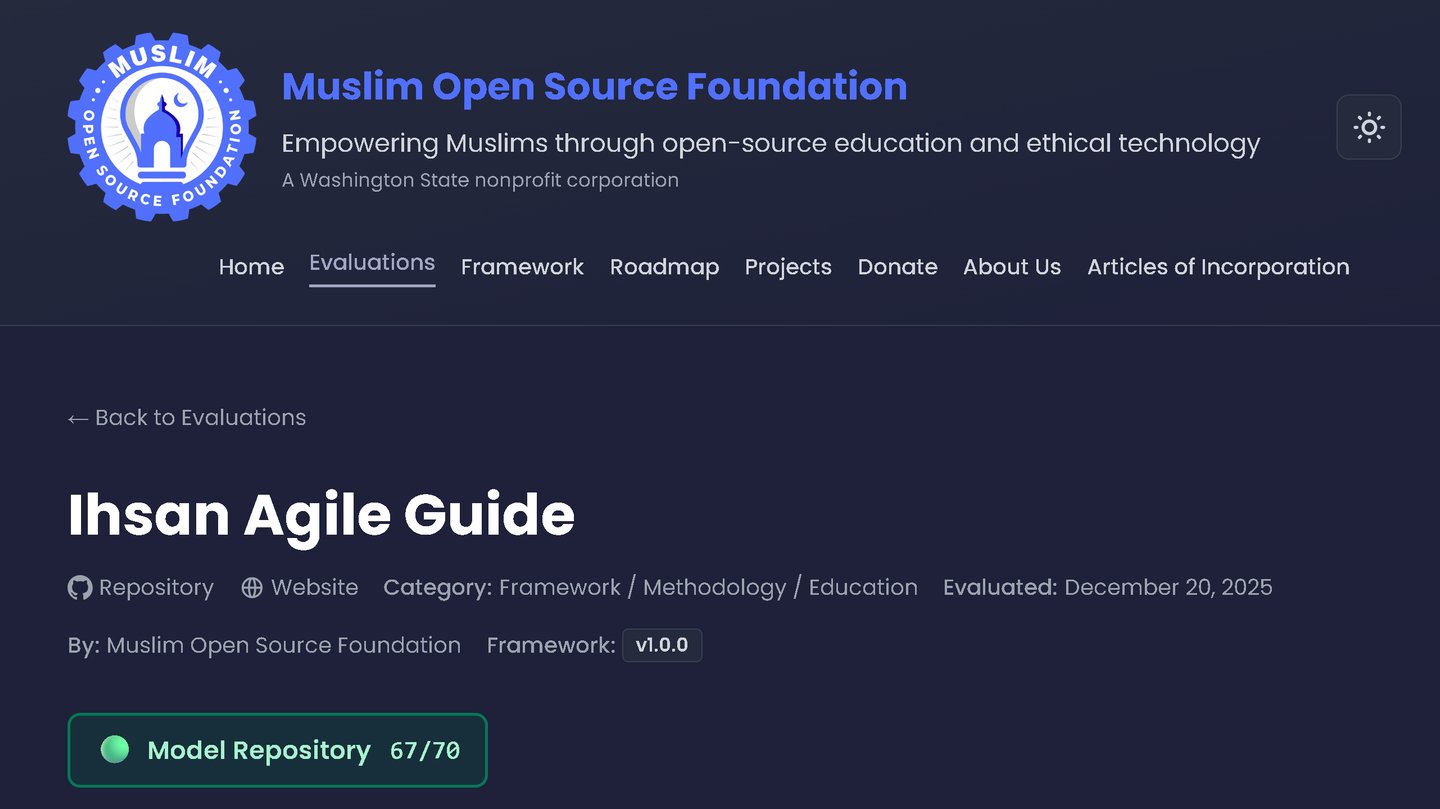
Independent Evaluation by the Muslim Open-Source Foundation
The Ihsan Agile GitHub repository — which contains the full Ihsan Agile Guide and supporting artefacts — was independently evaluated by the Muslim Open Source Foundation Dec 20, 2025 and recognised as a 🟢Model Repository (67/70).
© 1447 AH / 2026 CE. All rights reserved.
"What is Ihsan (perfection)?" Allah's Messenger (ﷺ) replied, "To worship Allah as if you see Him, and if you cannot achieve this state of devotion then you must consider that He is looking at you."
Sahih al-Bukhari 50